UPDATED
TIME
45–65 minutes per session
GOAL
Build muscle
EQUIPMENT
Standard gym
SESSION
4 days · 10–12 sets per session
The upper lower split workout
Four available gym days give you room to train your upper and lower body twice each week. Upper sessions combine pressing and pulling; lower sessions cover squats, hinges, knee curls and calves. You keep three days free from this lifting plan.
This plan suits people familiar with the exercises. Follow each table once; the six illustrated lifts explain existing work, not extra sets. A and B distinguish sessions, not difficulty levels.
Upper A · 12 sets
Exercise | Sets × reps | Rest |
|---|---|---|
Dumbbell bench press | 3 × 8–12 | 2–3 min |
Chest-supported dumbbell row | 3 × 8–12 | 2–3 min |
Seated dumbbell shoulder press | 2 × 8–12 | 2–3 min |
Lat pulldown | 2 × 8–12 | 2–3 min |
Dumbbell curl | 2 × 8–12 | 90–120 sec |
Lower A · 11 sets
Exercise | Sets × reps | Rest |
|---|---|---|
Goblet squat | 3 × 8–12 | 2–3 min |
Dumbbell Romanian deadlift | 3 × 8–12 | 2–3 min |
Seated leg curl | 3 × 10–15 | 90–120 sec |
Standing dumbbell calf raise | 2 × 12–20 | 90–120 sec |
Upper B · 12 sets
Exercise | Sets × reps | Rest |
|---|---|---|
Incline dumbbell press | 3 × 8–12 | 2–3 min |
Chest-supported dumbbell row | 3 × 8–12 | 2–3 min |
Lat pulldown | 2 × 8–12 | 2–3 min |
Dumbbell lateral raise | 2 × 12–20 | 90–120 sec |
Overhead cable triceps extension | 2 × 10–15 | 90–120 sec |
Lower B · 10 sets
Exercise | Sets × reps | Rest |
|---|---|---|
Goblet squat | 3 × 8–12 | 2–3 min |
Dumbbell reverse lunge | 2 × 8–12 per leg | 90–120 sec |
Seated leg curl | 3 × 10–15 | 90–120 sec |
Standing dumbbell calf raise | 2 × 12–20 | 90–120 sec |
Keep roughly two controlled repetitions available on most sets. Log dumbbells per dumbbell, single held weights as one dumbbell, and machines by the selected stack setting. Lunges are per leg and curls per arm. The push day, pull day and leg day guides show the accessory movements; use the set counts here for this programme.
A busy week still counts
If you miss Thursday, continue with Upper B at the next opportunity. Keep the session order rather than doubling Friday’s workload.
Rehearse the first lift
Before your first lift, perform two or three progressively heavier practice sets. Rehearse later movements lightly as needed; these sets are separate from the table.
Your upper and lower exercise guide
Left shows the start of the lifting phase; right shows its finish. For squats and hinges, lower from standing first.
Dumbbell bench press

START ·
Weights beside chest
FINISH ·
Press above chest
MUSCLES WORKED
Chest, front delts & triceps
SETS × REPS
3 × 8–12
REST
2–3 min
Cue:
Keep your head and back supported, feet planted and wrists above elbows. Lower beside your chest, then press upwards without crashing the weights together.
Weight:
Log kilograms per dumbbell: two 12 kg weights mean 12 kg each, 24 kg combined. Example only.
Alternate exercise:
Machine chest press.
Chest-supported dumbbell row

START ·
Arms hanging down
FINISH ·
Row towards your ribs
MUSCLES WORKED
Lats, mid-back, rear delts & biceps
SETS × REPS
3 × 8–12
REST
2–3 min
Cue:
Support your chest on an incline bench and plant your feet. Row towards your lower ribs, then lower your arms without lifting your chest.
Weight:
Log kilograms per dumbbell: two 12 kg weights mean 12 kg each. Example only.
Alternate exercise:
Chest-supported machine row.
Seated dumbbell shoulder press

START ·
Weights beside shoulders
FINISH ·
Press overhead
MUSCLES WORKED
Front and side delts & triceps
SETS × REPS
2 × 8–12
REST
2–3 min
Cue:
Sit against a nearly upright backrest, feet stable and elbows slightly forwards. Press from shoulder level to overhead without leaning further back.
Weight:
Log kilograms per dumbbell, using a load you can control through a comfortable range.
Alternate exercise:
Seated machine shoulder press.
Goblet squat

START ·
Lowered squat
FINISH ·
Stand tall
MUSCLES WORKED
Quads, glutes & adductors
SETS × REPS
3 × 8–12
REST
2–3 min
Cue:
Hold one dumbbell at your chest and lower between your hips, heels grounded and knees following your toes. Stand from the lowered position shown left.
Weight:
Log one dumbbell’s total weight: 16 kg means one 16 kg dumbbell. Example only.
Alternate exercise:
Hack squat machine.
Dumbbell Romanian deadlift
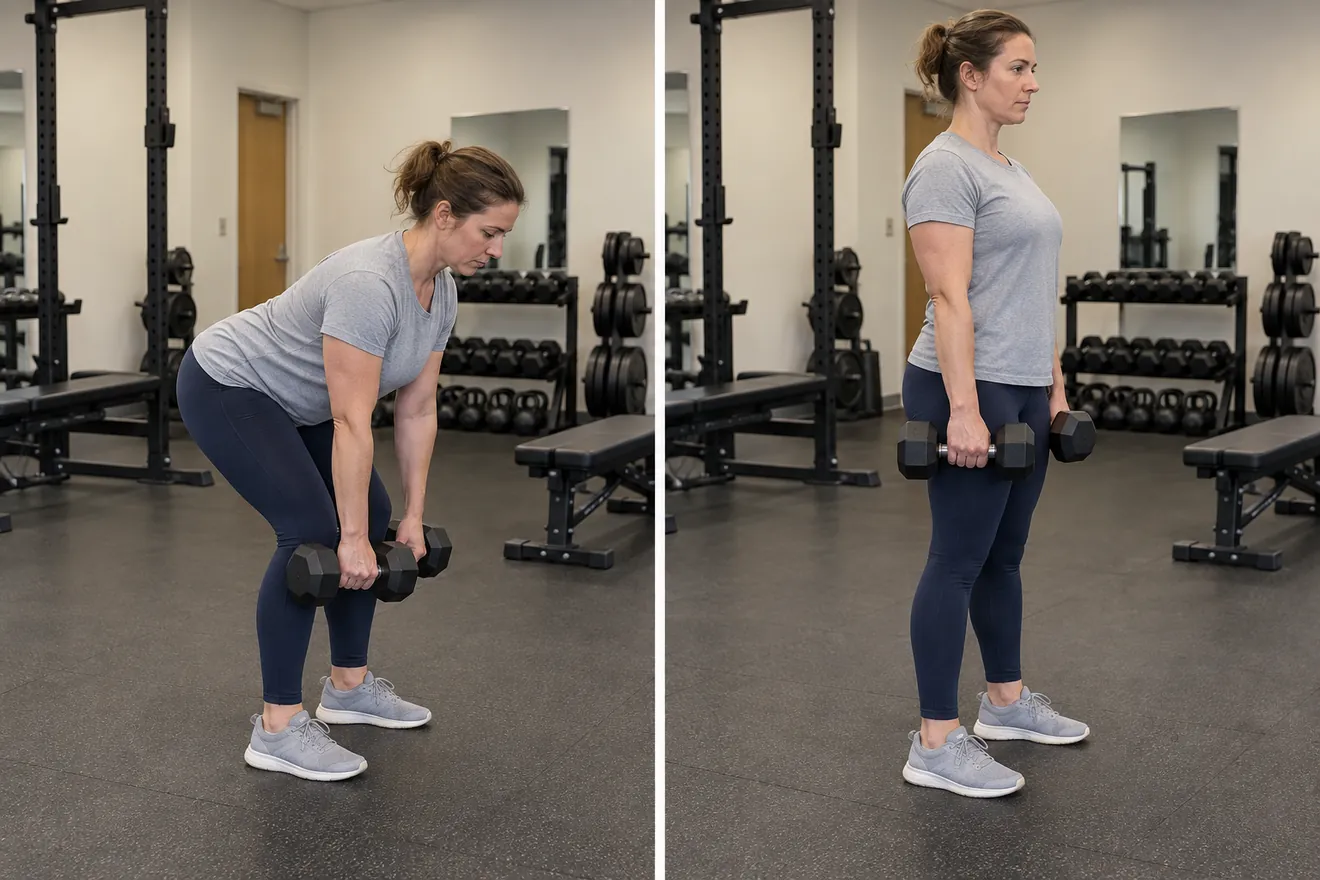
START ·
Hips back, weights low
FINISH ·
Stand tall
MUSCLES WORKED
Hamstrings & glutes
SETS × REPS
3 × 8–12
REST
2–3 min
Cue:
From standing, soften your knees and push your hips back, weights close to your legs. Stop before your back position changes, then stand tall.
Weight:
Log kilograms per dumbbell: two 14 kg weights mean 14 kg each, 28 kg combined. Example only.
Alternate exercise:
Barbell Romanian deadlift.
Seated leg curl
START ·
Legs nearly straight
FINISH ·
Curl beneath the seat
MUSCLES WORKED
Hamstrings
SETS × REPS
3 × 10–15
REST
90–120 sec
Cue:
Align your knees with the machine pivot and secure the thigh pad. Curl your lower legs beneath the seat without lifting your hips, then return slowly.
Weight:
Log the selected stack setting; compare sessions on the same machine with the same setup.
Alternate exercise:
Lying leg curl.
Keep a separate record for each lift
Track your row on both upper days, using the same bench setup. These entries show repetitions across three sets; 12 kg per dumbbell is an example of notation, not a suggested starting load.
START HERE
10 / 9 / 8
12 kg per dumbbell · reps per set
BUILD REPS
11 / 10 / 9
12 kg per dumbbell · reps per set
TOP OF THE RANGE
12 / 12 / 12
Try the smallest increase next
Increase the load when every set reaches the top of the range with consistent technique and effort. Review recovery if several lifts repeatedly decline.
Your 4 day upper lower split
Place a rest day between the two pairs of sessions. This calendar keeps each upper session away from the next upper session, and does the same for lower-body work.
MON
Upper A
TUE
Lower A
WED
Rest
THU
Upper B
FRI
Lower B
SAT
Rest
SUN
Rest
Upper lower vs push pull legs
Upper lower split training combines more muscle groups per visit, which suits four available days. A push pull legs routine gives more focused sessions, but repeating all three twice requires six visits. Choose based on your calendar and recovery, not the name of the split.
Planning your training week
Behind the advice
This is a sample programme. Adjust the exercises and workload to your experience and recovery.
Supalifts builds your training plan around your schedule and equipment, times your rest and suggests your next weight. Coming soon to Android and iPhone.
Get early access
↗