
UPDATED
TIME
45–65 minutes per session
GOAL
Build muscle
EQUIPMENT
Standard gym
SESSION
3 session types · 3 or 6 days
Your push pull legs routine
A split answers one question: what will you train today? Push covers chest, shoulders and triceps; pull covers back and biceps; legs covers your lower body. The exercises and the work you recover from still determine what those days involve.
Use this push pull legs workout plan if you enjoy focused sessions and already know the basic movements. Start with the three complete tables below; the six illustrated lifts are technique references drawn from them, not an extra workout to add on.
Push session · 13 sets
Exercise | Sets × reps | Rest |
|---|---|---|
Dumbbell bench press | 3 × 8–12 | 2–3 min |
Incline dumbbell press | 2 × 8–12 | 2–3 min |
Seated dumbbell shoulder press | 2 × 8–12 | 2–3 min |
Dumbbell lateral raise | 3 × 12–20 | 90–120 sec |
Overhead cable triceps extension | 3 × 10–15 | 90–120 sec |
Pull session · 12 sets
Exercise | Sets × reps | Rest |
|---|---|---|
Lat pulldown | 3 × 8–12 | 2–3 min |
Chest-supported dumbbell row | 3 × 8–12 | 2–3 min |
Reverse cable fly | 2 × 12–20 | 90–120 sec |
Dumbbell curl | 2 × 8–12 | 90–120 sec |
Hammer curl | 2 × 10–15 | 90–120 sec |
Legs session · 13 sets
Exercise | Sets × reps | Rest |
|---|---|---|
Goblet squat | 3 × 8–12 | 2–3 min |
Dumbbell Romanian deadlift | 3 × 8–12 | 2–3 min |
Seated leg curl | 3 × 10–15 | 90–120 sec |
Dumbbell reverse lunge | 2 × 8–12 per leg | 90–120 sec |
Standing dumbbell calf raise | 2 × 12–20 | 90–120 sec |
These are working sets. Use loads that leave roughly two controlled repetitions available. Log paired dumbbells per dumbbell, the goblet squat as one dumbbell, and machines by their stack settings. Lunges are per leg; curls are per arm. Log dual-cable fly loads per side. For detailed accessories and alternatives, read the push day workout, pull day workout and leg day workout.
Changing from three days to six?
Do not automatically double every working set. Start with fewer sets per session and increase only if performance and recovery remain steady.
Warm up for the session in front of you
Before your first lift, perform two or three progressively heavier practice sets. Rehearse later movements lightly as needed; these sets are separate from the table.
Your main push pull legs exercises
Left shows the start of the lifting phase; right shows its finish. For squats and hinges, lower from standing first.
Dumbbell bench press

START ·
Weights beside chest
FINISH ·
Press above chest
MUSCLES WORKED
Chest, front delts & triceps
SETS × REPS
3 × 8–12
REST
2–3 min
Cue:
Keep your head and back supported, feet planted and wrists above elbows. Lower beside your chest, then press upwards without crashing the weights together.
Weight:
Log kilograms per dumbbell: two 12 kg weights mean 12 kg each, 24 kg combined. Example only.
Alternate exercise:
Machine chest press.
Seated dumbbell shoulder press

START ·
Weights beside shoulders
FINISH ·
Press overhead
MUSCLES WORKED
Front and side delts & triceps
SETS × REPS
2 × 8–12
REST
2–3 min
Cue:
Sit against a nearly upright backrest, feet stable and elbows slightly forwards. Press from shoulder level to overhead without leaning further back.
Weight:
Log kilograms per dumbbell, using a load you can control through a comfortable range.
Alternate exercise:
Seated machine shoulder press.
Lat pulldown

START ·
Arms overhead
FINISH ·
Bar at upper chest
MUSCLES WORKED
Lats, upper back & biceps
SETS × REPS
3 × 8–12
REST
2–3 min
Cue:
Secure your thighs under the pad, feet flat. Pull the bar towards your upper chest in front of your head, then return without swinging.
Weight:
Log the selected stack setting, not per arm; compare sessions on the same machine.
Alternate exercise:
Assisted pull-up.
Chest-supported dumbbell row

START ·
Arms hanging down
FINISH ·
Row towards your ribs
MUSCLES WORKED
Lats, mid-back, rear delts & biceps
SETS × REPS
3 × 8–12
REST
2–3 min
Cue:
Support your chest on an incline bench and plant your feet. Row towards your lower ribs, then lower your arms without lifting your chest.
Weight:
Log kilograms per dumbbell: two 12 kg weights mean 12 kg each. Example only.
Alternate exercise:
Chest-supported machine row.
Goblet squat

START ·
Lowered squat
FINISH ·
Stand tall
MUSCLES WORKED
Quads, glutes & adductors
SETS × REPS
3 × 8–12
REST
2–3 min
Cue:
Hold one dumbbell at your chest and lower between your hips, heels grounded and knees following your toes. Stand from the lowered position shown left.
Weight:
Log one dumbbell’s total weight: 16 kg means one 16 kg dumbbell. Example only.
Alternate exercise:
Hack squat machine.
Dumbbell Romanian deadlift
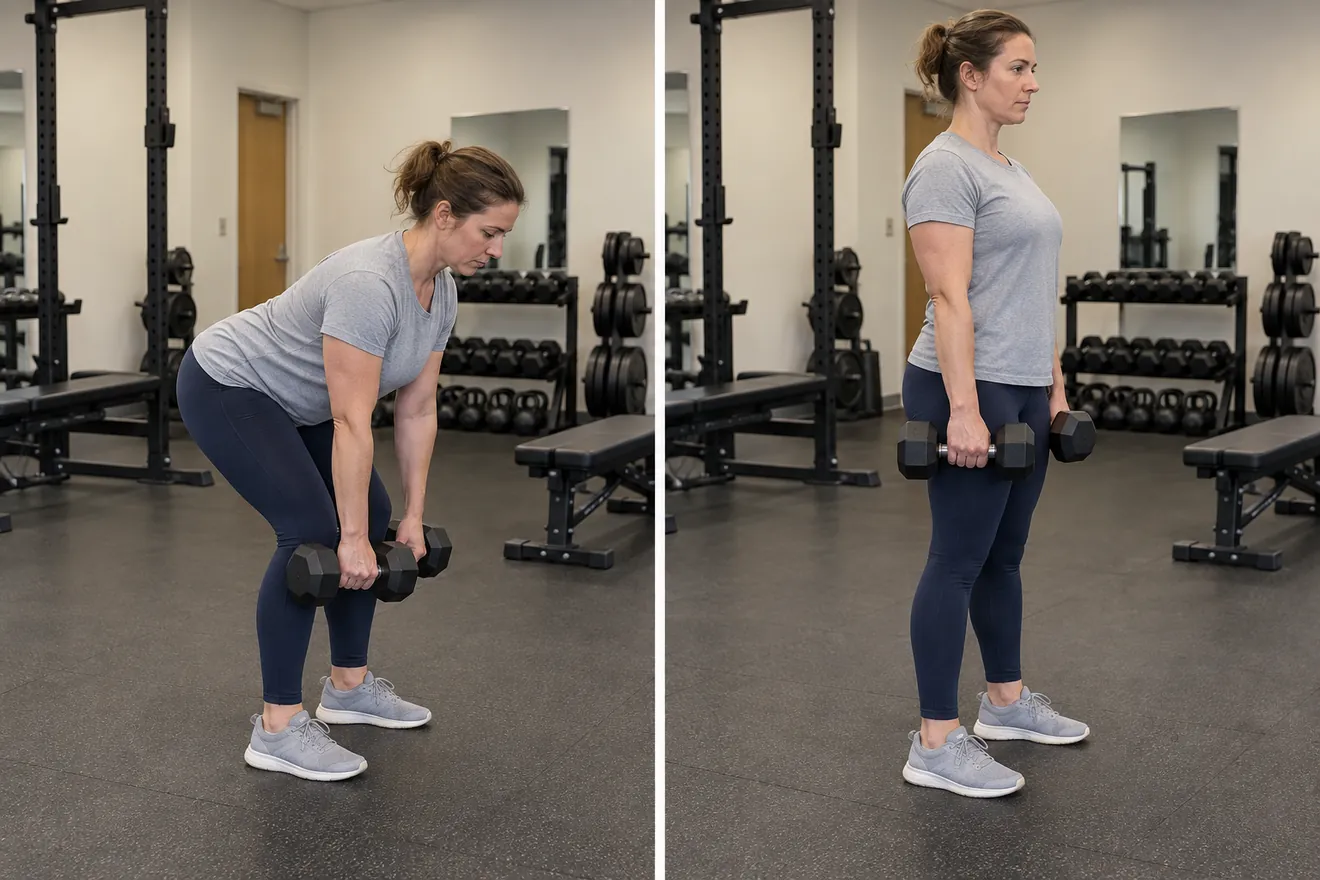
START ·
Hips back, weights low
FINISH ·
Stand tall
MUSCLES WORKED
Hamstrings & glutes
SETS × REPS
3 × 8–12
REST
2–3 min
Cue:
From standing, soften your knees and push your hips back, weights close to your legs. Stop before your back position changes, then stand tall.
Weight:
Log kilograms per dumbbell: two 14 kg weights mean 14 kg each, 28 kg combined. Example only.
Alternate exercise:
Barbell Romanian deadlift.
Let your log guide the next session
Track each lift separately. A pulldown log on the same machine could develop like this; the 40 kg stack setting is an example, not a prescribed starting weight.
START HERE
10 / 9 / 8
40 kg stack setting · reps per set
BUILD REPS
11 / 10 / 9
40 kg stack setting · reps per set
TOP OF THE RANGE
12 / 12 / 12
Try the smallest increase next
Increase the load when every set reaches the top of the range with consistent technique and effort. Review recovery if several lifts repeatedly decline.
Choose your training frequency
Push pull legs 3 day split
Train Push on Monday, Pull on Wednesday and Legs on Friday. This gives each session its own day and leaves four non-lifting days. Each muscle group gets its main session once weekly; with only three available days, a full-body programme is another practical option.
Push pull legs 6 day split
Repeat the sequence twice, as shown below. Six-day training gives each main session two slots, but also means more gym visits and potentially much more weekly work. This is an option for people who can recover from it, not the next mandatory stage.
MON
Push
TUE
Pull
WED
Legs
THU
Rest
FRI
Push
SAT
Pull
SUN
Legs
If four days fit your life better, consider the upper lower split. Choose the calendar first, then adjust the work to match it.
Choosing a split
Behind the advice
This is a sample programme. Adjust training volume and frequency to your schedule and recovery.
Supalifts builds your training plan around your schedule and equipment, times your rest and suggests your next weight. Coming soon to Android and iPhone.
Get early access
↗