UPDATED
TIME
45–60 minutes
GOAL
Build muscle
EQUIPMENT
Standard gym
SESSION
5 exercises · 12 sets
The pull day workout
Walk into the gym on pull day and you have plenty of choices. The harder part is deciding what deserves a place in your workout.
Start with these five pull exercises: two back movements, one rear-shoulder exercise, and two curls. The sets below are working sets; warm up separately.
Exercise
Sets × reps
Rest
Lat pulldown
Back · vertical pull
3 × 8–12
2–3 min
Chest-supported dumbbell row
Back · horizontal pull
3 × 8–12
2–3 min
Reverse cable fly
Rear shoulders
2 × 12–20
90–120 sec
Dumbbell curl
Biceps
2 × 8–12
90–120 sec
Hammer curl
Arms · neutral grip
2 × 10–15
90–120 sec
Dumbbell weights are recorded per dumbbell; machine weights use the selected stack setting. Choose weights that leave roughly two controlled repetitions in reserve at the end of most sets. Treat that as an estimate while you learn to judge effort.
Only have 30 minutes?
Keep the pulldown, row, and dumbbell curl. You’ll cover two back movements and direct biceps work.
Warm up with the movements you’ll use
Do two or three gradually heavier warm-up sets of pulldowns. Keep them comfortable: you’re practising the movement and approaching your working weight.
Before your first row, use a lighter set to check your bench position and range of motion.
Your pull day exercise guide
Keep each movement controlled. The left image shows the start; the right shows the end of the lifting phase. Return to the start to complete the repetition.
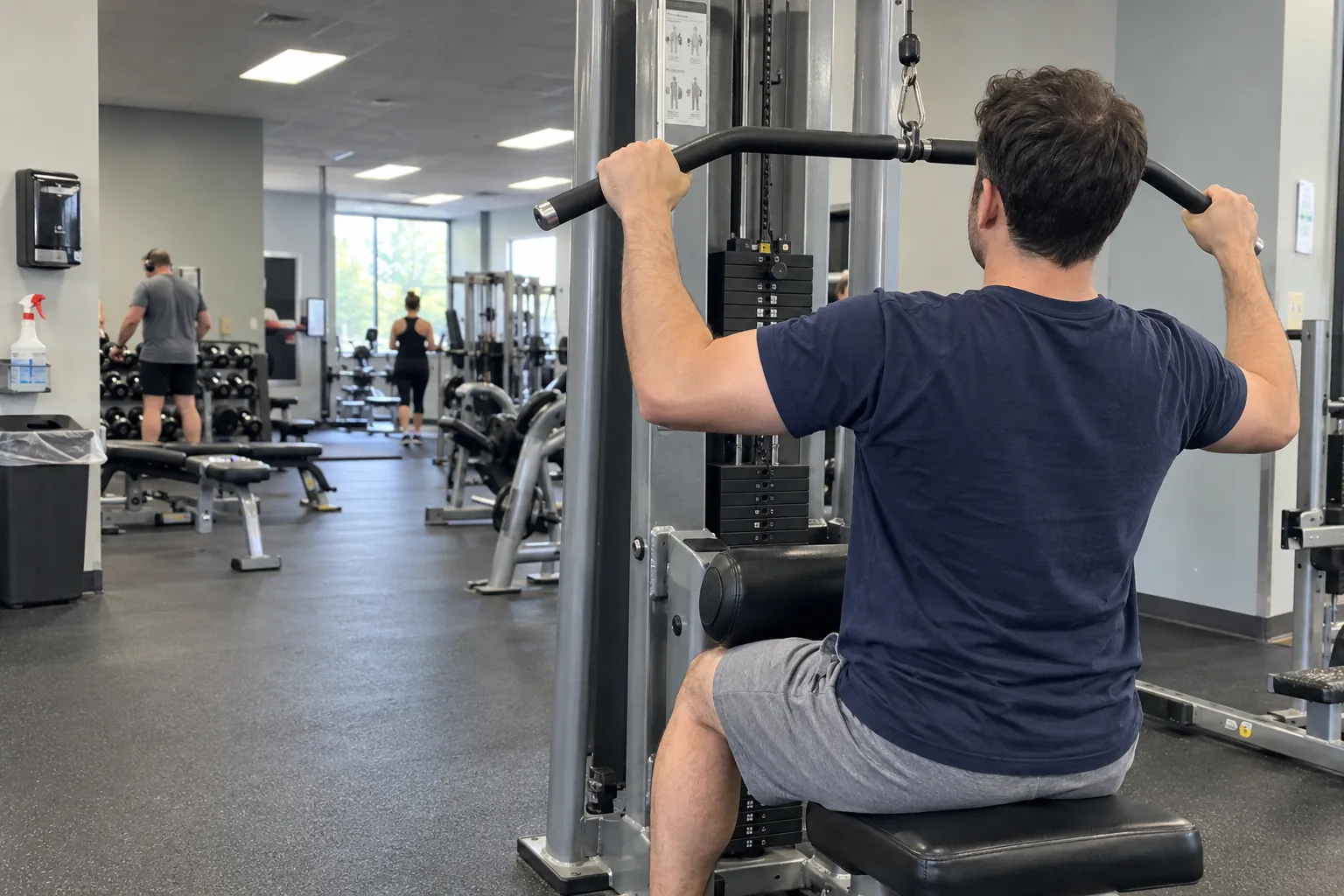
Lat pulldown

START ·
Arms overhead
FINISH ·
Bar at upper chest
MUSCLES WORKED
Lats, upper back & biceps
SETS × REPS
3 × 8–12
REST
2–3 min
Cue:
Bring your elbows down towards your sides. Keep a small, steady backward lean and pull the bar in front of your head. Control the return overhead.
Weight:
Record the machine’s selected stack setting. A setting of 40 kg means 40 kg on that stack—not 40 kg per arm. Different machines can feel different at the same setting.
Alternate exercise:
Assisted pull-up.
Chest-supported dumbbell row
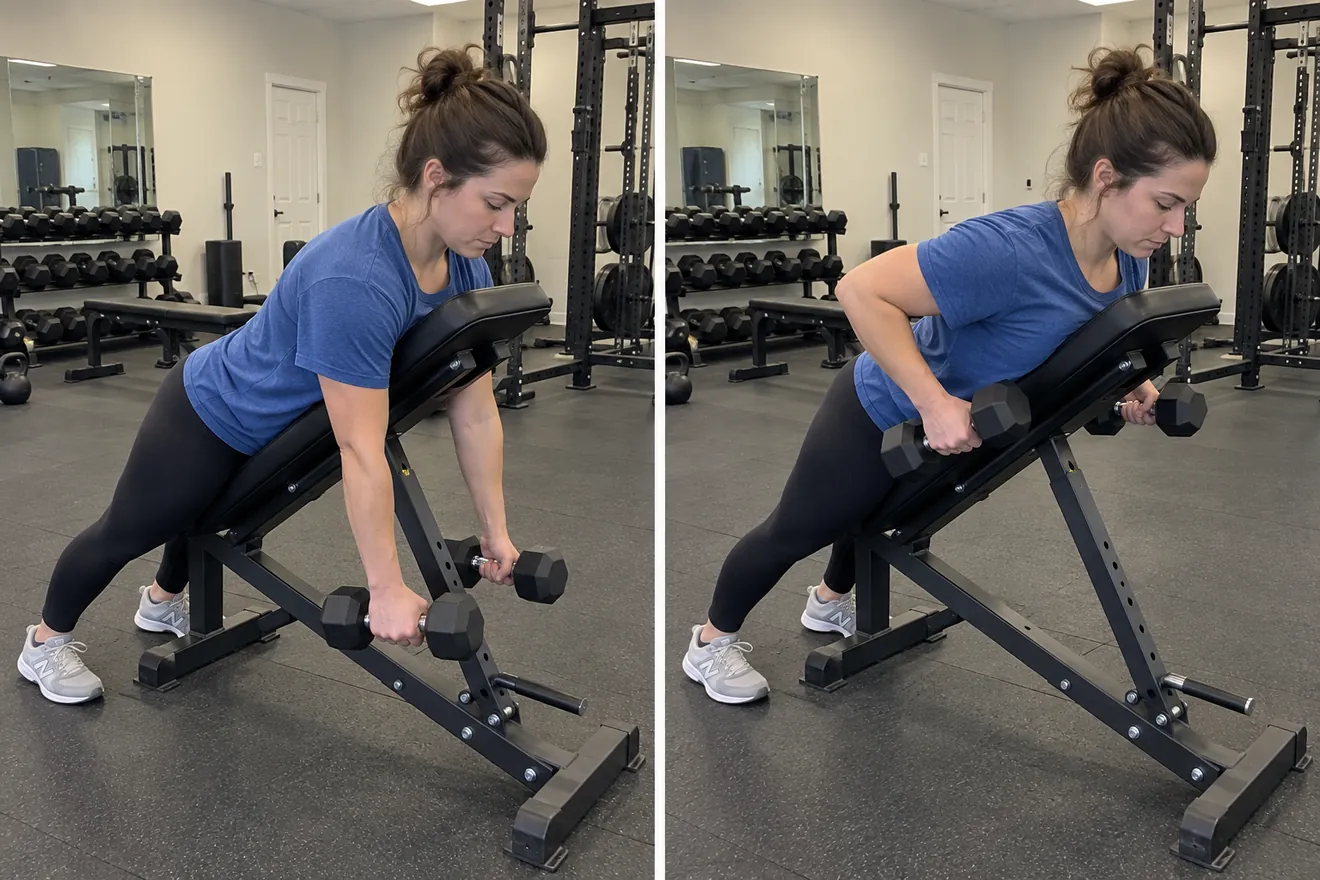
START ·
Arms hanging down
FINISH ·
Row towards your ribs
MUSCLES WORKED
Lats, mid-back, rear delts & biceps
SETS × REPS
3 × 8–12
REST
2–3 min
Cue:
Keep your chest against the pad as you draw your elbows back. Lower the dumbbells until your arms hang beneath you, without lifting your chest to finish a rep.
Weight:
Dumbbell loads are per dumbbell. “12 kg per dumbbell” means one 12 kg weight in each hand, 24 kg combined. This is a notation example, not a starting-weight recommendation.
Alternate exercise:
Chest-supported machine row.
Reverse cable fly

START ·
Hands in front
FINISH ·
Open your arms out
MUSCLES WORKED
Rear delts & upper back
SETS × REPS
2 × 12–20
REST
90–120 sec
Cue:
Hold opposite cable handles, keep a soft bend in your elbows, and open your arms to the sides. Use a comfortable range and avoid shrugging or turning the movement into a row.
Weight:
With two independent stacks, log the setting per side. For example, “2.5 kg per side” means each stack is set to 2.5 kg. Cable ratios vary between machines.
Alternate exercise:
Reverse pec deck.
Dumbbell curl

START ·
Arms by your sides
FINISH ·
Curl with palms up
MUSCLES WORKED
Biceps & brachialis
SETS × REPS
2 × 8–12
REST
90–120 sec
Cue:
Keep your upper arms beside your torso and curl without rocking backwards. Keep your wrists straight and lower the weights under control.
Weight:
Log kilograms per dumbbell. The rep range is per arm; when curling both arms together, each simultaneous curl counts as one rep.
Alternate exercise:
Cable curl.
Hammer curl

START ·
Palms facing in
FINISH ·
Keep thumbs uppermost
MUSCLES WORKED
Brachialis, brachioradialis & biceps
SETS × REPS
2 × 10–15
REST
90–120 sec
Cue:
Keep your palms facing each other throughout the curl. Lift without swinging your body or bending your wrists, then lower with control.
Weight:
Log kilograms per dumbbell, with repetitions per arm. Choose this load independently of your regular curl weight.
Alternate exercise:
Rope hammer curl on a low cable.
Earn the next weight increase
Keep the weight steady while you build repetitions within the target range. Your pulldown log might look like this, using the selected weight on the same machine:
START HERE
10 / 9 / 8
40 kg stack setting · reps per set
BUILD REPS
11 / 10 / 9
40 kg stack setting · reps per set
TOP OF THE RANGE
12 / 12 / 12
Try a small increase next
These are examples, not a timetable. You may repeat the same numbers for several sessions. Add weight once every set reaches the top of the range with consistent technique and the intended effort.
Where pull day fits
Already following push–pull–legs? Use this pull day routine in your pull slot. Here’s one possible six-session week:
MON
Push
TUE
Pull
WED
Legs
THU
Rest
FRI
Push
SAT
Pull
SUN
Legs
Choose that schedule only if it fits your time and recovery. With three gym days a week, a full-body programme makes it easier to train each major muscle group more than once.
Before you head to the gym
Behind the advice
This is a sample session. Adjust the work to your experience and recovery.
Supalifts builds your training plan around your schedule and equipment, times your rest and suggests your next weight. Coming soon to Android and iPhone.
Get early access
↗