
UPDATED
TIME
50–65 minutes
GOAL
Build muscle
EQUIPMENT
Standard gym
SESSION
5 exercises · 13 sets
Your leg day workout exercises
A useful lower-body session should give your knees, hips and ankles something to do. It should also leave you with a plan you can repeat, rather than a collection of exercises chosen to make walking home difficult.
These five movements cover a squat, a hinge, a knee curl, a lunge and a calf raise. The session suits gym-goers practising the basics with controlled loads. Goblet squats keep the setup simple, although stronger lifters may eventually need a machine or barbell option when holding the dumbbell becomes the limit.
Exercise
Sets × reps
Rest
Goblet squat
Legs · squat
3 × 8–12
2–3 min
Dumbbell Romanian deadlift
Legs · hip hinge
3 × 8–12
2–3 min
Seated leg curl
Hamstrings · knee flexion
3 × 10–15
90–120 sec
Dumbbell reverse lunge
Legs · single-leg work
2 × 8–12 per leg
90–120 sec
Standing dumbbell calf raise
Calves · ankle extension
2 × 12–20
90–120 sec
The table lists working sets. Keep about two controlled repetitions available on most sets, and allow longer rest if your breathing prevents a steady setup. Dumbbell pairs are logged per dumbbell; the goblet squat and calf raise each use one dumbbell. Lunges are counted per leg, and the curl uses the machine’s selected stack setting.
Build into the session
If you are returning after a break, start with two sets of each movement. Add work only when your technique and recovery remain comfortable.
Practise the squat and hinge first
Take a few minutes of easy movement, then rehearse body-weight squats and unloaded hip hinges. Follow with two or three gradually heavier goblet-squat sets, keeping them well short of fatigue.
Before Romanian deadlifts, use a lighter pair to find the point where you can hinge without changing your back position. A warm-up should make the working sets feel more familiar, not become another demanding workout.
Your leg day workout routine, explained
Use the images to compare the two ends of the lifting phase. For squats, hinges and lunges, the left panel is the lowered position and the right is standing. Set up from standing first, then lower with control.
Goblet squat

START ·
Lowered squat
FINISH ·
Stand tall
MUSCLES WORKED
Quads, glutes & adductors
SETS × REPS
3 × 8–12
REST
2–3 min
Cue:
Hold one dumbbell at your chest and lower between your hips, heels grounded and knees following your toes. Stand from the lowered position shown left.
Weight:
Log one dumbbell’s total weight: 16 kg means one 16 kg dumbbell. Example only.
Alternate exercise:
Hack squat machine.
Dumbbell Romanian deadlift
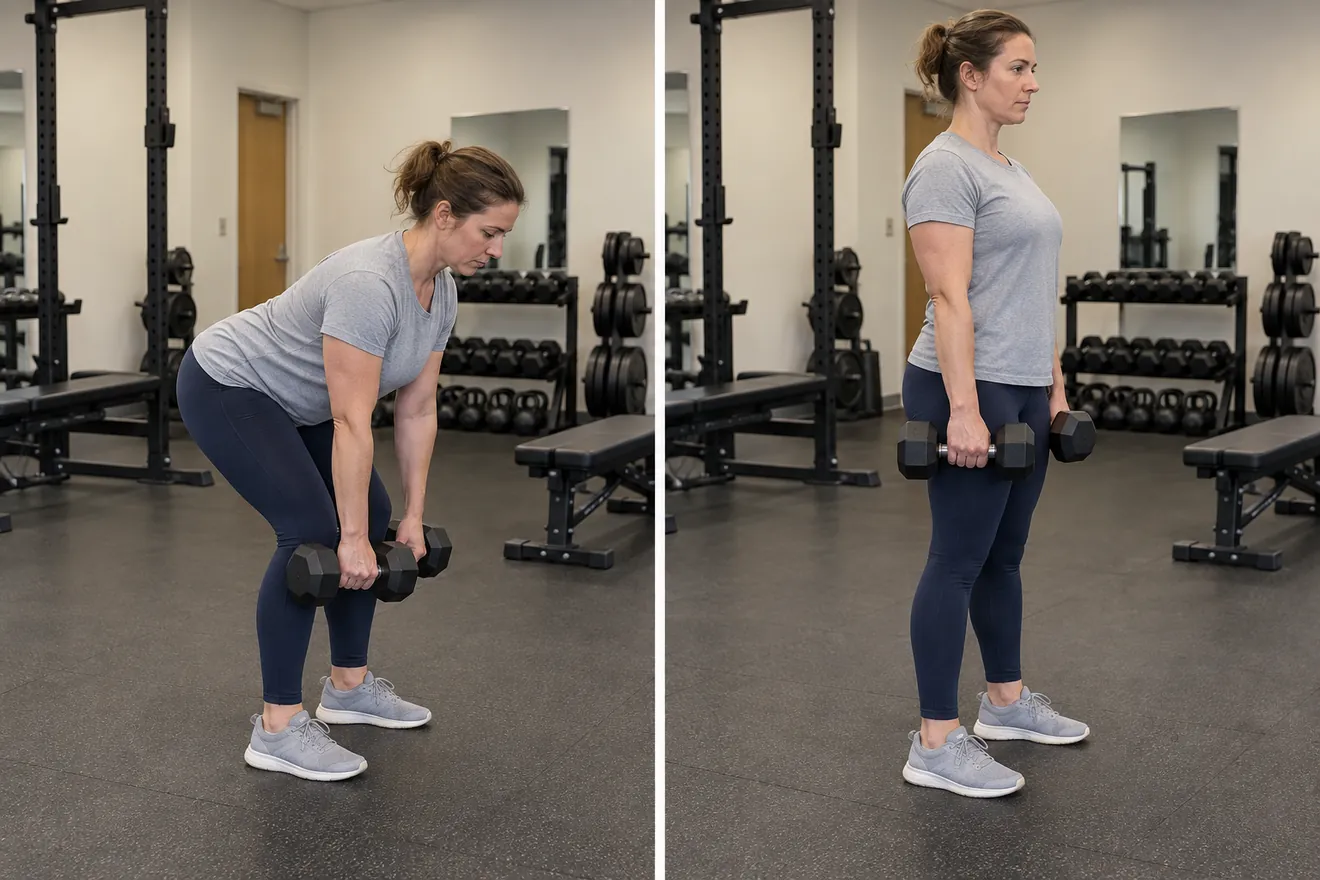
START ·
Hips back, weights low
FINISH ·
Stand tall
MUSCLES WORKED
Hamstrings & glutes
SETS × REPS
3 × 8–12
REST
2–3 min
Cue:
From standing, soften your knees and push your hips back, weights close to your legs. Stop before your back position changes, then stand tall.
Weight:
Log kilograms per dumbbell: two 14 kg weights mean 14 kg each, 28 kg combined. Example only.
Alternate exercise:
Barbell Romanian deadlift.
Seated leg curl
START ·
Legs nearly straight
FINISH ·
Curl beneath the seat
MUSCLES WORKED
Hamstrings
SETS × REPS
3 × 10–15
REST
90–120 sec
Cue:
Align your knees with the machine pivot and secure the thigh pad. Curl your lower legs beneath the seat without lifting your hips, then return slowly.
Weight:
Log the selected stack setting; compare sessions on the same machine with the same setup.
Alternate exercise:
Lying leg curl.
Dumbbell reverse lunge

START ·
Lowered lunge
FINISH ·
Return to standing
MUSCLES WORKED
Quads & glutes
SETS × REPS
2 × 8–12 per leg
REST
90–120 sec
Cue:
Step backwards from standing and lower your rear knee towards the floor. Keep the front foot planted and push through it to return.
Weight:
Log kilograms per dumbbell and reps per leg; eight on each leg is one set of eight per leg.
Alternate exercise:
Supported split squat.
Standing dumbbell calf raise

START ·
Heels lowered
FINISH ·
Rise onto your forefeet
MUSCLES WORKED
Calves
SETS × REPS
2 × 12–20
REST
90–120 sec
Cue:
Hold stable support with both forefeet on a secure low step. Lower your heels comfortably, then rise without bouncing or bending your knees.
Weight:
Log the single dumbbell’s weight; use body weight if carrying a load compromises balance.
Alternate exercise:
Standing calf raise machine.
Progress one movement at a time
Keep a separate log for each exercise. Here is a goblet-squat example using one dumbbell; the numbers are repetitions in each of three sets, and the load is only an illustration.
START HERE
10 / 9 / 8
One 16 kg dumbbell · reps per set
BUILD REPS
11 / 10 / 9
One 16 kg dumbbell · reps per set
TOP OF THE RANGE
12 / 12 / 12
Try the smallest increase next
Increase the load once you can repeat the top of the range with consistent depth and effort. If your arms struggle to hold the weight before your legs do, consider the listed alternate exercise and begin a new log for it. Do not compare its numbers directly with the goblet squat.
Give your legs room to recover
This lower-body routine fits alongside a push day workout and pull day workout. In a six-session push pull legs routine, the week could look like this:
MON
Push
TUE
Pull
WED
Legs
THU
Rest
FRI
Push
SAT
Pull
SUN
Legs
Count demanding running, sport and other lower-body sessions when deciding how much work to do. If your second leg session repeatedly loses repetitions at the same effort, reduce a few sets or add recovery time before assuming you need a harder programme.
Leg training questions
Behind the advice
This is a sample session. Choose loads and ranges you can control, and adjust for recovery.
ACSM resistance training guidance ↗
Maeo et al., Medicine and Science in Sports and Exercise, 2021 ↗
Supalifts builds your training plan around your schedule and equipment, times your rest and suggests your next weight. Coming soon to Android and iPhone.
Get early access
↗